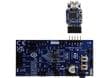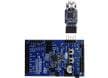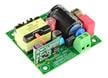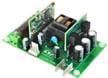

STEVAL-EDUKIT01

STMicroelectronics
511-STEVAL-EDUKIT01
STEVAL-EDUKIT01

Tillverk:

Beskrivning:
Strömhantering, IC-utvecklingsverktyg Evaluation kit for education on motor control and control systems

På lager: 9

Lager:
9
Kan skickas omedelbart
På beställningen:
9
Förväntad 2026-02-25
Fabrikens ledtid:
3
Veckor Uppskattad tillverkningstid i fabriken för kvantiteter som är större än vad som visas.
Minst: 1   Flera: 1   Maximalt: 5
Enhetspris:
-,-- kr
Ext. pris:
-,-- kr
Est. Pris:
Denna produkt levereras UTAN KOSTNAD

Prissättning (SEK)

Antal Enhetspris
Ext. pris
1.742,58 kr 1.742,58 kr

Produktattribut Attributvärde Välj attribut
STMicroelectronics
Produktkategori: Strömhantering, IC-utvecklingsverktyg
RoHS-direktivet:  
Evaluation Kits
Motor/Motion Controller & Driver
100 V to 240 V
L6474PD
Märke: STMicroelectronics
Förpackning: Bulk
Produkttyp: Power Management IC Development Tools
Underkategori: Development Tools
Enhetens vikt: 2,359 kg
Hittade produkter:
Markera minst en kryssruta för att visa liknande produkter
Markera minst en kryssruta ovan för att visa liknande produkter i denna kategori.
Attribut som valts: 0

TARIC:
8473302000
CNHTS:
8543709990
USHTS:
9023000000
ECCN:
3A991.a.2

STEVAL-EDUKIT01 Evaluation Kit

STMicroelectronics STEVAL-EDUKIT01 Evaluation Kit is designed to represent a complex, non-linear, and unstable oscillator for university-level robotics projects. It consists of a transparent structure holding a free-swinging pendulum with movement stabilized by a stepper motor and feedback from a high-performance rotary encoder reading the pendulum angle. The STSW-EDUKIT01 firmware includes critical, high-speed algorithms that interpret encoder data and allows the stepper motor to counter pendulum movement so it remains vertical. The educational set, along with a real-time Matlab viewer and interface, helps build an understanding of Arm®-based embedded architecture (STM32CubeIDE) and stepper motor control. STMicroelectronics STEVAL-EDUKIT01 Evaluation Kit also covers real-time systems based on proportional, integral, and derivative (PID) control, as well as more advanced techniques.